
October 2026 Issue of Becker’s ASC Review
On The Cover
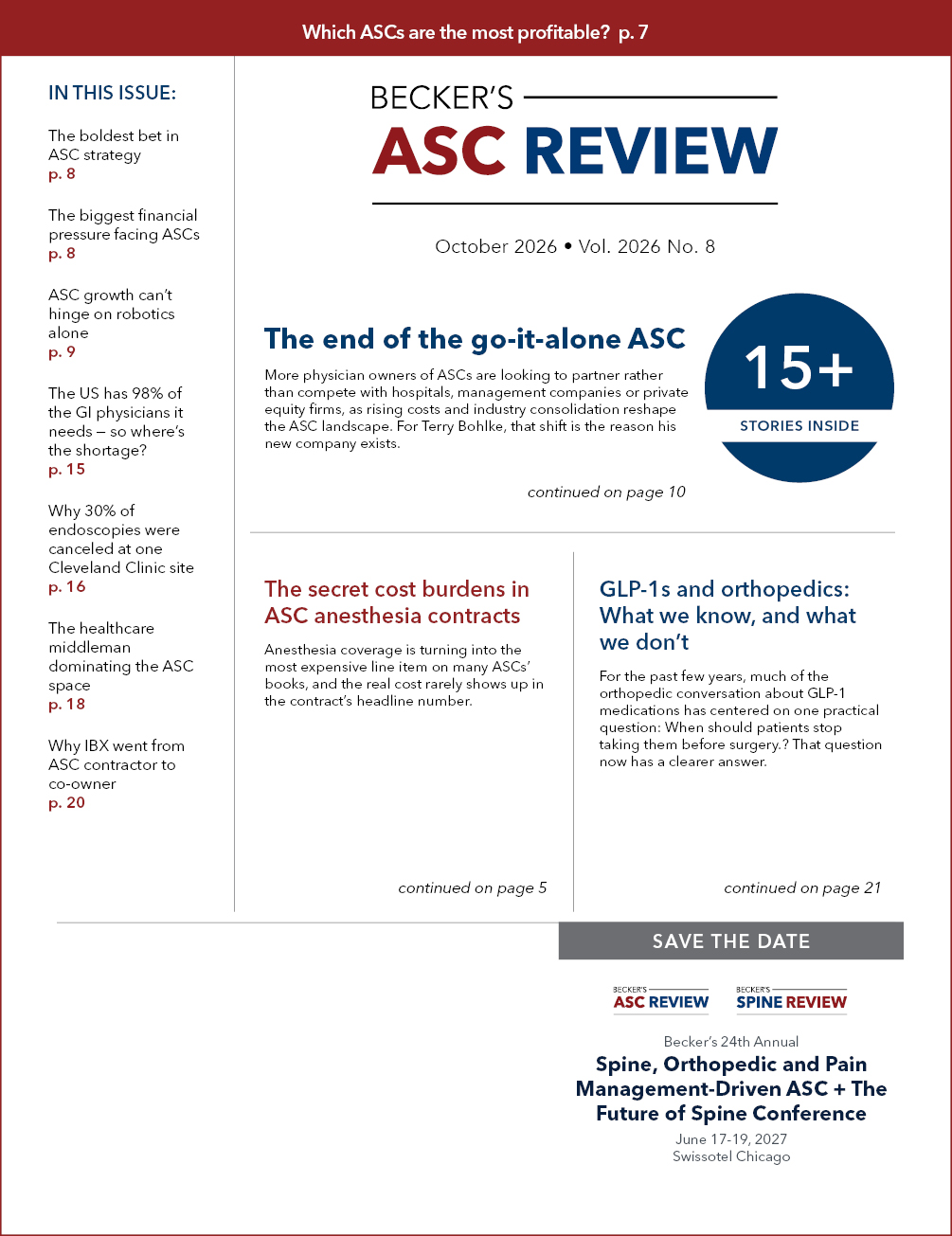
Which ASCs are the most profitable?
Nonprofit, health system-affiliated ASCs earn much higher margins than for-profit centers, according to a new study of Pennsylvania facilities.
The end of the go-it-alone ASC
More physician owners of ASCs are looking to partner rather than compete with hospitals, management companies or private equity firms, as rising costs and industry consolidation reshape the ASC landscape. For Terry Bohlke, that shift is the reason his new company exists.
The secret cost burdens in ASC anesthesia contracts
Anesthesia coverage is turning into the most expensive line item on many ASCs’ books, and the real cost rarely shows up in the contract’s headline number.
GLP-1s and orthopedics: What we know, and what we don’t
For the past few years, much of the orthopedic conversation about GLP-1 medications has centered on one practical question: When should patients stop taking them before surgery.? That question now has a clearer answer.
The boldest bet in ASC strategy
Shelly Harris, RN, administrator of Advanced Surgical Care Clearwater (Fla.), told Becker’s the boldest bet in ASC strategy right now is going after higher-acuity, higher-paying cases that can safely move out of the hospital.
The biggest financial pressure facing ASCs
For ASCs, staffing costs are not just about how many employees are on the payroll — they are about matching that payroll to a case volume that can change quickly throughout the year.
ASC growth can’t hinge on robotics alone
When Kaiser Permanente’s Largo (Md.) Medical Center became the first freestanding ASC in the health system’s Mid-Atlantic region to offer robotic surgery in 2020, the program started small: general surgery only, performing about 10 hernia procedures a month. Five years and more than 1,700 robotic procedures later, that single ASC now performs nearly 40 robotic operations monthly across general surgery, gynecology and urology — and Kaiser Permanente is using that track record to expand robotic capability to its Tysons Corner (Va.) Medical Center.
The US has 98% of the GI physicians it needs — so where’s the shortage?
The long-standing narrative that there is a shortage of gastroenterologists in the U.S. is starting to shift, as recent data reveal more details about exactly where access to GI care is the most strained.
Why 30% of endoscopies are canceled at Cleveland Clinic
A Cleveland Clinic study of more than 45,000 scheduled outpatient endoscopic procedures found socioeconomic disadvantage, Medicaid coverage and procedure type were associated with higher odds of last-minute cancellations and no-shows.
The healthcare middleman dominating the ASC space
The ASC industry has been on a steady growth path in recent years as ambulatory developments shift to the center of health system growth strategies and third-party groups continue to capitalize on opportunities for mergers and acquisitions in the space.
Why IBX went from ASC contractor to co-owner
Independence Blue Cross has contracted with ASCs for years, but its new ownership stake in a surgery center company signals the insurer decided contracts alone were not enough.
ASC Management
The secret cost burdens in ASC anesthesia contracts
Anesthesia coverage is turning into the most expensive line item on many ASCs’ books, and the real cost rarely shows up in the contract’s headline number.
Capital is chasing ASCs — and the physicians behind them
Commercial real estate firm Northmarq published a Sept. 14, 2026, report warning that outpatient healthcare real estate demand does not automatically convert into facility revenue, even as the U.S. population age 75 and older is projected to grow 54.7% by 2036.
Which ASCs are the most profitable?
Nonprofit, health system-affiliated ASCs earn much higher margins than for-profit centers, according to a new study of Pennsylvania facilities.
The biggest financial pressure facing ASCs
For ASCs, staffing costs are not just about how many employees are on the payroll — they are about matching that payroll to a case volume that can change quickly throughout the year.
The boldest bet in ASC strategy
Shelly Harris, RN, administrator of Advanced Surgical Care Clearwater (Fla.), told Becker’s the boldest bet in ASC strategy right now is going after higher-acuity, higher-paying cases that can safely move out of the hospital.
Thought Leadership
ASC growth can’t hinge on robotics alone
When Kaiser Permanente’s Largo (Md.) Medical Center became the first freestanding ASC in the health system’s Mid-Atlantic region to offer robotic surgery in 2020, the program started small: general surgery only, performing about 10 hernia procedures a month. Five years and more than 1,700 robotic procedures later, that single ASC now performs nearly 40 robotic operations monthly across general surgery, gynecology and urology — and Kaiser Permanente is using that track record to expand robotic capability to its Tysons Corner (Va.) Medical Center.
The end of the go-it-alone ASC
More physician owners of ASCs are looking to partner rather than compete with hospitals, management companies or private equity firms, as rising costs and industry consolidation reshape the ASC landscape. For Terry Bohlke, that shift is the reason his new company exists.
Orthopedics
When ASC ownership becomes a matter of survival
For independent orthopedic surgeons, owning a surgery center was once a way to get ahead. Increasingly, it may be the only way to keep up.
Why the biggest wins for robotics are still ahead
Robotic-assisted surgery has moved past the novelty stage in orthopedics, and one of the field’s earliest adopters says the technology’s biggest wins are still ahead — both in what it can prove and in who it can help.
Gastroenterology
The US has 98% of the GI physicians it needs — so where’s the shortage?
The long-standing narrative that there is a shortage of gastroenterologists in the U.S. is starting to shift, as recent data reveal more details about exactly where access to GI care is the most strained.
Why 30% of endoscopies are canceled at Cleveland Clinic
A Cleveland Clinic study of more than 45,000 scheduled outpatient endoscopic procedures found socioeconomic disadvantage, Medicaid coverage and procedure type were associated with higher odds of last-minute cancellations and no-shows.
The new math working against GI margins
Gastroenterology practices are absorbing pressure from two directions at once this year, and physicians and administrators say the damage is showing up procedure by procedure, on individual claims and individual schedules.
The colonoscopy reimbursement cut GI ASCs didn’t see coming
Gastroenterologists performing colonoscopies in ASC and hospital outpatient settings are absorbing a targeted physician pay cut in 2026, one that arrives on top of a 40-year erosion in procedure reimbursement and that most high-volume GI programs did not anticipate in their budget planning.
Transactions
The healthcare middleman dominating the ASC space
The ASC industry has been on a steady growth path in recent years as ambulatory developments shift to the center of health system growth strategies and third-party groups continue to capitalize on opportunities for mergers and acquisitions in the space.
As independent ASC ownership shrinks, are physicians’ stakes worth more?
Fewer physicians hold equity in their ASCs than a decade ago. But for the ones who still do, that stake is worth more than ever.
Why IBX went from ASC contractor to co-owner
Independence Blue Cross has contracted with ASCs for years, but its new ownership stake in a surgery center company signals the insurer decided contracts alone were not enough.
Spine
GLP-1s and orthopedics: What we know, and what we don’t
For the past few years, much of the orthopedic conversation about GLP-1 medications has centered on one practical question: When should patients stop taking them before surgery.? That question now has a clearer answer.
Dr. Roger Härtl on the new test for ‘minimally invasive’ spine surgery
“Minimally invasive” has become one of spine surgery’s most powerful promises. It is also remarkably difficult to define.
