
July/August 2026 Issue of Becker’s ASC Review
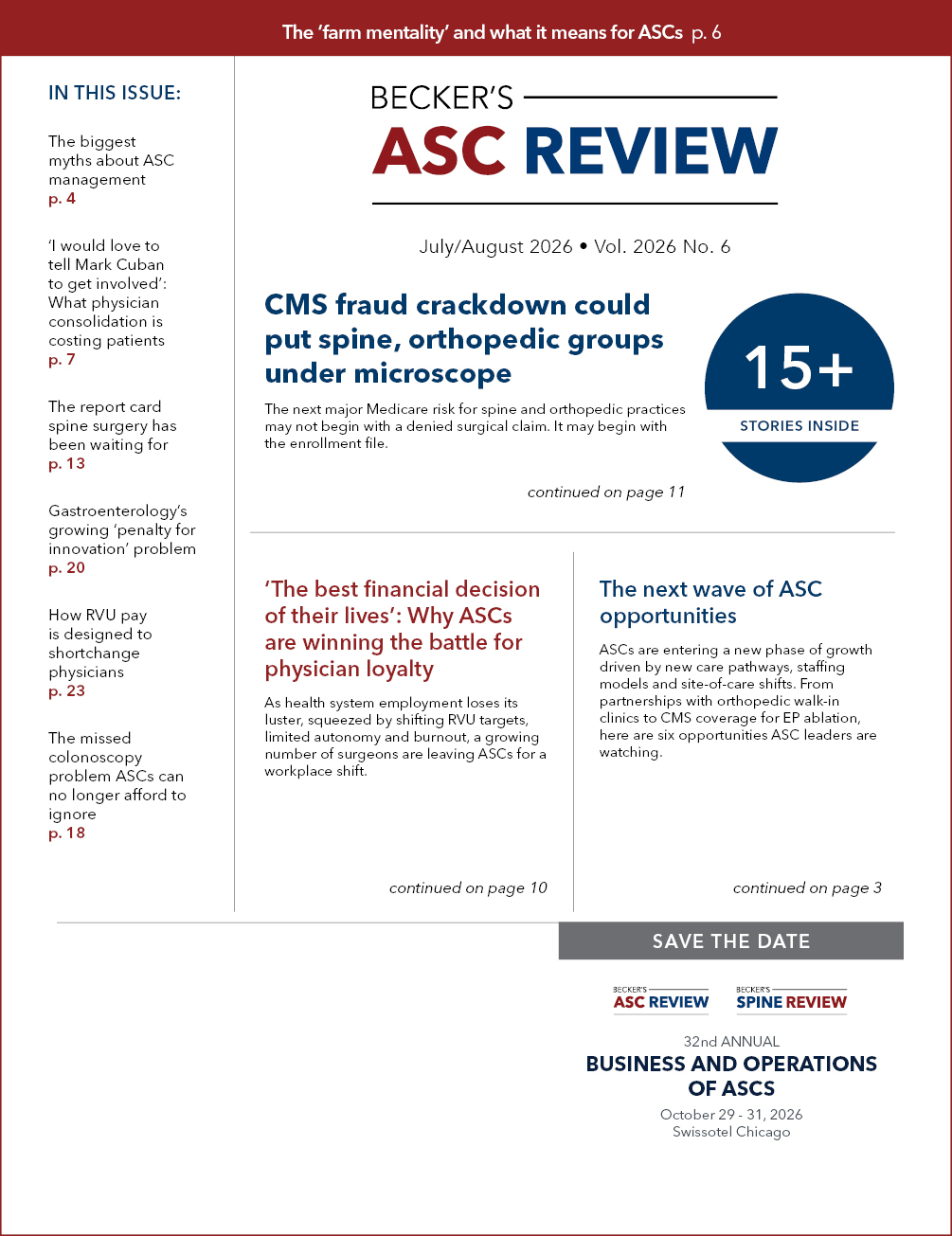
On The Cover
The ‘farm mentality’ and what it means for ASCs
The financial sustainability and success of any ASC generally requires a careful balance of revenue generation and cost-savings — but this equation is more complicated in ASCs.
CMS fraud crackdown could put spine, orthopedic groups under microscope
The next major Medicare risk for spine and orthopedic practices may not begin with a denied surgical claim. It may begin with the enrollment file.
‘The best financial decision of their lives’: Why ASCs are winning the battle for physician loyalty
As health system employment loses its luster, squeezed by shifting RVU targets, limited autonomy and burnout, a growing number of surgeons are leaving ASCs for a workplace shift.
The next wave of ASC opportunities
ASCs are entering a new phase of growth driven by new care pathways, staffing models and site-of-care shifts.
The biggest myths about ASC management
Industry leaders say that some of the most widely held beliefs in ASC management may be actively doing harm, rather than just being outdated.
‘I would love to tell Mark Cuban to get involved’: What physician consolidation is costing patients
Ahmed Hasan, MD, has been practicing gastroenterology independently in Pennsylvania’s Lehigh Valley for 30 years. Six independent GI groups with their own ASCs used to operate alongside him in the Greater Lehigh Valley, a total of roughly 60 gastroenterologists. Today, two remain.
The report card spine surgery has been waiting for
For years, spine surgery has been judged by what happens early. How long was the hospital stay? Were there complications? Did the patient need another operation? Did pain improve in the first year? Praveen Mummaneni, MD, believes those questions miss the larger story.
Gastroenterology’s growing ‘penalty for innovation’ problem
A growing disconnect between innovation and reimbursement could become one of gastroenterology’s most consequential disruptors in 2026, Tyler Berzin, MD, associate professor of medicine at Harvard Medical School and a gastroenterologist at Beth Israel Deaconess Medical Center, both based in Boston, told Becker’s.
How RVU pay is designed to shortchange physicians
Productivity-based compensation is often pitched to physicians as a fairer model — work more, earn more, with a direct line between output and pay.
The missed colonoscopy problem ASCs can no longer afford to ignore
Roughly half of patients with an abnormal stool-based colorectal cancer screening result never complete the follow-up colonoscopy. For years, that statistic has been framed primarily as a public health problem.
ASC Management
The next wave of ASC opportunities
ASCs are entering a new phase of growth driven by new care pathways, staffing models and site-of-care shifts.
The biggest myths about ASC management
Industry leaders say that some of the most widely held beliefs in ASC management may be actively doing harm, rather than just being outdated.
What physicians get wrong about the ASC migration
Many physicians who could be thriving in the outpatient setting aren’t, according to Marcelo Hochman, MD.
The ‘farm mentality’ and what it means for ASCs
The financial sustainability and success of any ASC generally requires a careful balance of revenue generation and cost-savings — but this equation is more complicated in ASCs.
Thought Leadership
‘I would love to tell Mark Cuban to get involved’: What physician consolidation is costing patients
Ahmed Hasan, MD, has been practicing gastroenterology independently in Pennsylvania’s Lehigh Valley for 30 years. Six independent GI groups with their own ASCs used to operate alongside him in the Greater Lehigh Valley, a total of roughly 60 gastroenterologists. Today, two remain.
The ‘alpha physician’ test driving this ASC company’s success
When it comes to building a successful ASC or physician practice, most conversations start with capital, location or case mix. But for Basheer Alismail, president of ASC and physician practice company Capital Surgical Solutions, alignment should be the first consideration.
Why the next generation of physicians might finally win back their power
For decades, physicians have watched autonomy erode as the great migration to health systems continues.
‘The best financial decision of their lives’: Why ASCs are winning the battle for physician loyalty
As health system employment loses its luster, squeezed by shifting RVU targets, limited autonomy and burnout, a growing number of surgeons are leaving ASCs for a workplace shift.
Orthopedics
CMS fraud crackdown could put spine, orthopedic groups under microscope
The next major Medicare risk for spine and orthopedic practices may not begin with a denied surgical claim. It may begin with the enrollment file.
The report card spine surgery has been waiting for
For years, spine surgery has been judged by what happens early. How long was the hospital stay? Were there complications? Did the patient need another operation? Did pain improve in the first year? Praveen Mummaneni, MD, believes those questions miss the larger story.
Gastroenterology
The missed colonoscopy problem ASCs can no longer afford to ignore
Roughly half of patients with an abnormal stool-based colorectal cancer screening result never complete the follow-up colonoscopy. For years, that statistic has been framed primarily as a public health problem.
The gastroenterologist pay gap
Gastroenterologists are among the highest-paid physicians in the country, pulling in an average of $530,000 in 2025, but a new Medscape survey suggests the paycheck doesn’t always match the pressure.
The potential ‘litigation wave’ headed for GI
GLP-1’s drugs continue to expand horizons in gastroenterology, bariatrics, diabetes and chronic disease care — but the scale of the drugs’ adoption could be creating new areas of risk management for physicians, according to a report published Risk & Insurance April 29.
Gastroenterology’s growing ‘penalty for innovation’ problem
A growing disconnect between innovation and reimbursement could become one of gastroenterology’s most consequential disruptors in 2026, Tyler Berzin, MD, associate professor of medicine at Harvard Medical School and a gastroenterologist at Beth Israel Deaconess Medical Center, both based in Boston, told Becker’s.
Transactions
Stark law demystified
The federal physician self-referral law — better known as the Stark law — was enacted in 1989 and aims to curb physician self-referrals that could drive overutilization and higher costs. Decades later, it remains one of healthcare’s most complex compliance regimes, and physician groups say it hasn’t kept pace with value-based care and the consolidation of the healthcare market.
How RVU pay is designed to shortchange physicians
Productivity-based compensation is often pitched to physicians as a fairer model — work more, earn more, with a direct line between output and pay.
